
Quarterly Financial Report for the Quarter ended December 31, 2023
ISSN 2561-7044
Table of Contents
- 1.0 Introduction
- 2.0 Highlights of the Fiscal Quarter and Fiscal Year-to-date Results
- 3.0 Risks and Uncertainties
- 4.0 Significant Changes in Relations to Operations, Personnel and Programs
- 5.0 Approval by Senior Officials
- Appendix A
- Appendix B
Statement outlining results, risks and significant changes in operations, personnel and programs
1.0 Introduction
This quarterly report has been prepared by management as required by section 65.1 of the Financial Administration Act, and in the form and manner prescribed by the Directive on Accounting Standards, GC 4400 Departmental Quarterly Financial Report. It has not been subject to an external audit or review. This quarterly report should be read in conjunction with the 2023-24 Main Estimates, the Supplementary Estimates (B) and the 2022-23 Operating Budget Carry Forward.
1.1 Authority, Mandate and Core Responsibility
The Office of the Director of Public Prosecutions (ODPP) was created on December 12, 2006, with the coming into force of the Director of Public Prosecutions Act. The ODPP is an independent prosecution service mandated to prosecute offences that are under the jurisdiction of the Attorney General of Canada.
The ODPP has one core responsibility, which is the provision of prosecution services in an independent, impartial and fair manner. The mandate of the ODPP includes:
- initiating and conducting federal prosecutions;
- intervening in proceedings that raise a question of public interest that may affect the conduct of prosecutions or related investigations;
- issuing guidelines to federal prosecutors;
- advising law enforcement agencies or investigative bodies on general matters relating to prosecutions and on particular investigations that may lead to prosecutions;
- communicating with the media and the public on all matters that involve the initiation and conduct of prosecutions;
- exercising the authority of the Attorney General of Canada in respect of private prosecutions; and
- exercising any other power or carry out any other duty or function assigned by the Attorney General of Canada that is compatible with the ODPP.
In addition, Internal Services are those groups of related activities and resources that the federal government considers to be services in support of programs and/or required to meet corporate obligations of an organization. Internal Services refer to the activities and resources of ten distinct services that support program delivery in the organization, regardless of the Internal Services delivery model in a department. These services are Management and Oversight Services; Communications Services; Legal Services; Human Resources Management Services; Financial Management Services; Information Management Services; Information Technology Services; Real Property Management Services; Materiel Management Services; and Acquisition Management Services.
1.2 Basis of Presentation
This quarterly report has been prepared by management using an expenditure basis of accounting. The accompanying Statement of Authorities includes the ODPP's spending authorities granted by Parliament, and those used by the ODPP consistent with the 2023-24 Main Estimates and the Supplementary Estimates (B) and the 2022-23 Operating Budget Carry Forward. This quarterly report has been prepared using a special purpose financial reporting framework designed to meet financial information needs with respect to the use of spending authorities.
The authority of Parliament is required before moneys can be spent by the Government. Approvals are given in the form of annually approved limits through appropriation acts, or through legislation in the form of statutory spending authority for specific purposes.
When Parliament is dissolved for the purposes of a general election, section 30 of the Financial Administration Act authorizes the Governor General, under certain conditions, to issue a special warrant authorizing the Government to withdraw funds from the Consolidated Revenue Fund. A special warrant is deemed to be an appropriation for the fiscal year in which it is issued.
The ODPP uses the full accrual method of accounting to prepare and present its annual departmental financial statements that are part of the departmental results reporting process. However, the spending authorities voted by Parliament remain on an expenditure basis.
2.0 Highlights of Fiscal Quarter and Fiscal Year-to-date Results
This section highlights the significant items that have contributed to the net increase in resources available for the year and net changes in actual expenditures for the quarter ended December 31, 2023, in comparison to the prior year.
The ODPP's financial structure is mainly composed of voted budgetary authorities namely, Vote 1 Program expenditures and vote-netted revenue (VNR) authority, as well as statutory authorities for contributions to employee benefit plans.
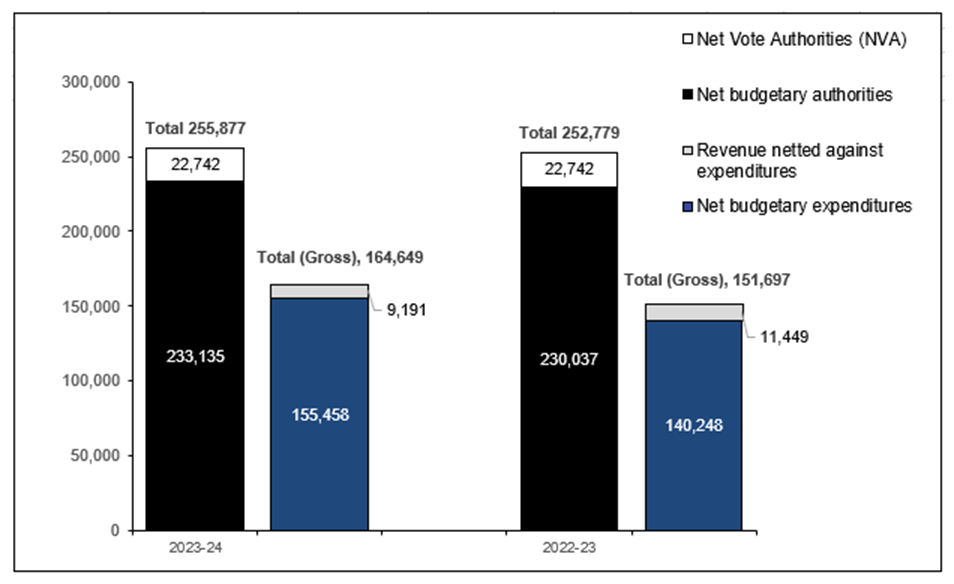
Text Description
Graph: Comparison of Budgetary Authorities and Expenditures as of December 31, 2023, and December 31, 2022 (in thousands of dollars)
The graph presents the ODPP's year-to-date net budgetary authorities and net budgetary expenditures as of December 31, 2023. The graph then presents the ODPP's total year-to-date net budgetary authorities and net budgetary expenditures as of December 31, 2022. The graph also shows the net vote authorities and the revenues netted against expenditures for the same period.
As of December 31, 2023, the net budgetary authorities of ODPP were $233,135 thousand and the net budgetary expenditures were $155,458 thousand. For the same period in the previous fiscal year, net budgetary authorities and net budgetary expenditures were $230,037 thousand and $140,248 thousand, respectively for the ODPP.
As of December 31, 2023, the net vote authorities of ODPP were $22,742 thousand and the revenues netted against expenditures were $9,191 thousand. For the same period in the previous fiscal year, net vote authorities and revenues netted against expenditures were $22,742 thousand and $11,449 respectively.
As of December 31, 2023, the total budgetary authorities, combining net budgetary authorities and net vote authorities of ODPP totalled $255,877 thousand, and the total budgetary expenditures, combining net budgetary expenditures and revenues netted against expenditures totalled $164,649 thousand. For the same period in the previous fiscal year, the total budgetary authorities and the total budgetary expenditures totalled $252,779 thousand and $151,697 thousand, respectively for the ODPP.
2.1 Significant Changes to Spending Authorities
For the period ended December 31, 2023, the ODPP had a total net spending authority of $233.1 million available for use as detailed in Chart 1 and APPENDIX A Statement of Authorities (unaudited). This amount represents the authorities provided in the 2023-24 Main Estimates, the Supplementary Estimates (B) and the 2022-23 operating budget carry forward. The increase of $3,1 million (1.3%), compared to total net spending authorities at the end of the third quarter of 2022-23 ($230 million) is mainly due to:
- funding received to assist the Canada Revenue Agency in fighting tax evasion in a complex global and digital environment ($2.9M); and
- funding received for collective agreements ratification ($4.8M)
Offset by a decrease related to the following:
- funding for the National Inquiry into Missing and Murdered Indigenous Women and Girls (MMIWG) ($2.7M);
- government refocusing spending initiative ($1M); and
- Other adjustments ($0.9M)
2.2 Significant Changes to Budgetary Expenditures and Revenues
The total net budgetary expenditures increased from $140.2 million (2022-23), to $155.5 million in 2023-24 compared to the same quarter of the previous fiscal year.
As illustrated in APPENDIX B Departmental budgetary expenditures by Standard Object (unaudited), during the third quarter, total gross budgetary expenditures increased by $12.1 million (25%) from $48.5 million in 2022-23 to $60.6 million in 2023-24.
The increase in operating expenditures, compared to the third quarter of 2022-23 is mainly attributable to:
- personnel expenditures increased by $9.0 million. This is mainly due to the ratification of collective agreements;
- professional, special & other services increased by $1.5 million. This is mainly due to an increase in legal services expenditures; and
- other subsidies and payments increased by $1.6 million, due to a payment of contingent liability.
2.3 Revenues Netted Against Expenditures
The ODPP has the authority to respend revenues received for providing services to other government departments and agencies. During the quarter ended December 31, 2023, there were $9.2 million in revenues applied toward expenditures. The ODPP had recorded $11.4 million in revenues during the same period the previous year, as detailed in Appendix B. This decrease of 2.2 million is mainly attributable to timing in recording revenue in the same quarter of the previous fiscal year and a change in recording of the employee benefit plan (EBP) adjustment quarterly, which was done on an annual basis in the past. However, the ODPP anticipates a reduction of revenue this fiscal year.
3.0 Risks and Uncertainties
The ODPP's key corporate risks are identified and assessed through an update of the Corporate Risk Profile (CRP). The ODPP will be working on an updated CRP in 2023-24, which is scheduled to be completed in February 2024.
The ODPP does not determine the number or types of cases referred to it for prosecution, nor does it control all of the levers of the criminal justice system. The capacity of law enforcement agencies or investigative bodies contributes to a risk that the organization might experience declining revenues, which could affect the resources needed to meet its prosecutorial obligations. The ODPP continues to monitor its business practices to ensure resources are managed in a cost-effective manner through caseload and resource planning. In addition, the ODPP has built flexibility within its budget management processes to allow for the adjustment of resources in the event that there is a requirement.
Given the nature of ODPP's core mandate, employees are required to receive and handle a high volume of records from investigators that contain sensitive information. This, in turn, increases the risk that sensitive information could be inadvertently disclosed or lost, resulting in a potential privacy breach, a threat to the security and safety of individuals, and/or the public questioning the ability of the organization to adequately protect the information under its control. In addition, employees and agents (private sector prosecutors) could be exposed to incidents of threat and intimidation due to the nature of their work for the ODPP. Both the security of information and the safety of staff risks are being mitigated by developing and implementing a long-term security awareness strategy aimed at improving the departmental security posture in the areas of physical security, information security and personnel security.
The current state of the ODPP national Agent Affairs Program could negatively impact the ODPP's ability to manage funds. To mitigate this risk, the ODPP will continue to strengthen the financial accountabilities of the program and related policies, procedures and delegations.
4.0 Significant Changes in Relations to Operations, Personnel and Programs
There have been no significant changes in relations to operations, personnel and programs over the last quarter.
5.0 Approval by Senior Officials
Approved by:
________________________
Kathleen Roussel
Director of Public Prosecutions and
Deputy Attorney General of Canada
Ottawa, Canada
________________________
Date
_______________________
Mélanie Lamoureux, CPA
Chief Financial Officer
Appendix A
| Fiscal year 2023-24 | Fiscal year 2022-23 | |||||
|---|---|---|---|---|---|---|
| (in thousands of dollars) | Total available for use for the year ending March 31, 2024* | Used during the quarter ended December 31, 2023 | Year-to-date used at quarter-end | Total available for use for the year ending March 31, 2023* | Used during the quarter ended December 31, 2022 | Year-to-date used at quarter-end |
| Vote 1 - Net Operating Expenditures | 211,082 | 50,513 | 138,918 | 209,228 | 37,491 | 124,934 |
| Budgetary Statutory Authorities: | ||||||
|
Contributions to Employee Benefit Plans
|
22,053 | 5,513 | 16,540 | 20,809 | 5,105 | 15,314 |
| Total Budgetary Statutory Authorities | 22,053 | 5,513 | 16,540 | 20,809 | 5,105 | 15,314 |
| Total Budgetary Authorities | 233,135 | 56,026 | 155,458 | 230,037 | 42,596 | 140,248 |
| Total Authorities | 233,135 | 56,026 | 155,458 | 230,037 | 42,596 | 140,248 |
* Includes authorities available for use and granted by Parliament at quarter-end.
Appendix B
| Fiscal year 2023-24 | Fiscal year 2022-23 | |||||
|---|---|---|---|---|---|---|
| (in thousands of dollars) | Planned expenditures for the year ending March 31, 2024* |
Expended during the quarter ended December 31, 2023 |
Year-to-date used at quarter-end |
Planned expenditures for the year ending March 31, 2023* | Expended during the quarter ended December 31, 2022 | Year-to-date used at quarter-end |
| Expenditures: | ||||||
| Personnel | 174,549 | 44,106 | 125,197 | 161,683 | 35,046 | 115,214 |
| Transportation and communications | 4,915 | 2,120 | 4,940 | 6,096 | 1,794 | 4,465 |
| Information | 389 | 182 | 370 | 616 | 87 | 263 |
| Professional, special & other services | 56,593 | 11,249 | 25,683 | 66,769 | 9,772 | 24,468 |
| Rentals | 4,461 | 623 | 1,840 | 3,791 | 724 | 1,811 |
| Repair and maintenance | 683 | 316 | 560 | 2,657 | 231 | 1,333 |
| Utilities, materials and supplies | 1,992 | 117 | 550 | 2,219 | 273 | 1,012 |
| Acquisition of machinery and equipment | 2,284 | 503 | 950 | 3,870 | 808 | 1,154 |
| Other subsidies and payments | 10,011 | 1,397 | 4,560 | 5,078 | (226) | 1,977 |
| Total gross budgetary expenditures | 255,877 | 60,612 | 164,649 | 252,779 | 48,509 | 151,697 |
| Less revenues netted against expenditures: | ||||||
| Legal services | (22,742) | (4,586) | (9,191) | (22,742) | (5,913) | (11,449) |
| Total net budgetary expenditures | 233,135 | 56,026 | 155,458 | 230,037 | 42,596 | 140,248 |
* Includes authorities available for use and granted by Parliament at quarter-end.
- Date modified: