
Annual Report on the Access to Information Act 2025-2026
ISSN 2561-8237 (Online)
Table of Contents
- 1 Introduction
- 2 The Public Prosecution Service of Canada
- 3 The ATIP Office
- 4 Delegated authorities
- 5 Performance
- 6 Proactive publication
- 7 Training and awareness activities
- 8 Policies, guidelines, and procedures
- 9 Initiatives and projects to improve access to information
- 10 Complaints and investigations
- 11 Monitoring compliance
- 12 Appendix A – Delegation order
1 Introduction
The Access to Information Act (the Act) came into force on July 1, 1983. The purpose of the Act is to enhance the accountability and transparency of federal government institutions in order to promote an open and democratic society and enable public debate on the conduct of those institutions. As part of that purpose, the Act provides a right of access to information found in records under the control of a government institution, in accordance with the following principles:
- government information should be available to the public;
- necessary exceptions to the right of access should be limited and specific; and
- decisions on the disclosure of government information should be reviewed independently of government.
The Public Prosecution Service of Canada (PPSC) became subject to the Act when it was established as an independent organization on December 12, 2006, with the coming into force of the Director of Public Prosecutions Act (Part 3 of the Federal Accountability Act).
Pursuant to section 94 of the Access to Information Act, this 2025-2026 Annual Report on the Act has been prepared for tabling in the House of Commons and the Senate. It provides an analysis of key statistics for the year, and also includes information on emerging trends, training activities, internal policies, guidelines, and procedures with respect to the PPSC’s administration of the Act.
The PPSC does not have any wholly-owned subsidiaries.
2 The Public Prosecution Service of Canada
The Public Prosecution Service of Canada (PPSC) is a national, independent, and accountable prosecuting authority. Our main objective is to prosecute cases under federal jurisdiction in a fair manner that is free from any improper influence. The Director of Public Prosecutions (DPP) is accountable to the Attorney General of Canada (AGC) and both the DPP and the AGC are required to perform their functions free of political influence or considerations. The PPSC is accountable to Parliament and has an obligation to the courts to present them with all available, relevant, and admissible evidence to preserve the fairness of the criminal justice system.
Mandate
The PPSC’s mandate is set out in the Director of Public Prosecutions Act (DPPA). The DPPA empowers the Director of Public Prosecutions (DPP), as Deputy Attorney General of Canada, to:
- initiate and conduct federal prosecutions;
- intervene in proceedings that raise a question of public interest that may affect the conduct of prosecutions or related investigations;
- issue guidelines to federal prosecutors;
- advise law enforcement agencies or investigative bodies on general matters relating to prosecutions and on particular investigations that may lead to prosecutions;
- communicate with the media and the public on all matters that involve the initiation and conduct of prosecutions;
- exercise the authority of the Attorney General of Canada in respect of private prosecutions; and
- exercise any other power or carry out any other duty or function assigned by the Attorney General of Canada that is compatible with the office of the DPP.
The DPPA also empowers the DPP to:
- initiate and conduct prosecutions under the Canada Elections Act; and
- act, when requested by the Attorney General of Canada, in matters under the Extradition Act and the Mutual Legal Assistance in Criminal Matters Act.
The PPSC is a distinct governmental organization managed by the DPP. The DPP has the rank and status of a deputy head (deputy minister) of a department but does not report to the Clerk of the Privy Council as is the case with other deputy ministers.
The ATIP Office
The ATIP Office holds primary responsibility for the implementation and administration of the Access to Information Act, along with the Privacy Act (collectively known as ATIP). The Office deals directly with the public in relation to access to information requests, liaises with Offices of Primary Interest (the subject matter experts) to prepare responses, and serves as the centre of ATIP expertise within the PPSC.
The ATIP Office fulfills its responsibilities by:
- processing access to information requests in accordance with the Access to Information Act, the Access to Information Regulations (the Regulations), and the Treasury Board of Canada’s policies, directives, and guidelines;
- responding to consultations submitted by other federal government institutions or other levels of government on PPSC records being considered for release, including the review of solicitor-client privilege in records related to criminal proceedings;
- providing advice to PPSC managers and employees regarding the application and interpretation of the Act, the Regulations, and Treasury Board policies and directives;
- reviewing PPSC policies, procedures, and agreements as well as making recommendations to ensure that they comply with the requirements of the Act;
- monitoring the PPSC’s compliance with the Act, the Regulations, and Treasury Board policies and directives;
- communicating with investigators of the Office of the Information Commissioner of Canada (OIC) to resolve complaints filed against the PPSC;
- reviewing documents relevant to proactive publication prior to their publication on the PPSC’s website, so that they do not contain information that is subject to exemptions or exclusions under the Act;
- delivering training sessions intended to familiarize the PPSC’s managers and employees with the requirements of the Act, the Regulations, and Treasury Board policies and directives;
- updating the PPSC’s chapter of the federal government’s publication known as Info Source: Sources of Government and Employee Information, which describes the functions, programs, activities, and related information holdings of government institutions subject to ATIP;
- submitting an annual statistical report on the administration of the Act to the Treasury Board of Canada Secretariat (TBS);
- preparing an annual report on the administration of theAct for tabling in both Houses of Parliament; and
- posting summaries of completed access to information requests to the Government of Canada’s Open Government Portal.
3.1 Organizational structure
The Director General, Communications and Parliamentary Affairs (CPA), acts as the PPSC’s ATIP Coordinator. The Director of the ATIP Office reports to the Director General, CPA.
During the period from April 1, 2025, to March 31, 2026, the ATIP Office comprised of the Director, two (2) Senior Advisors, two (2) Advisors, and one (1) ATIP Officer.
Section 96 of the Act allows for the PPSC to exchange ATIP services with another government institution within the same ministerial portfolio. There were no such service agreements undertaken during this period.
The following chart outlines the organizational structure of the ATIP Office on March 31, 2026:
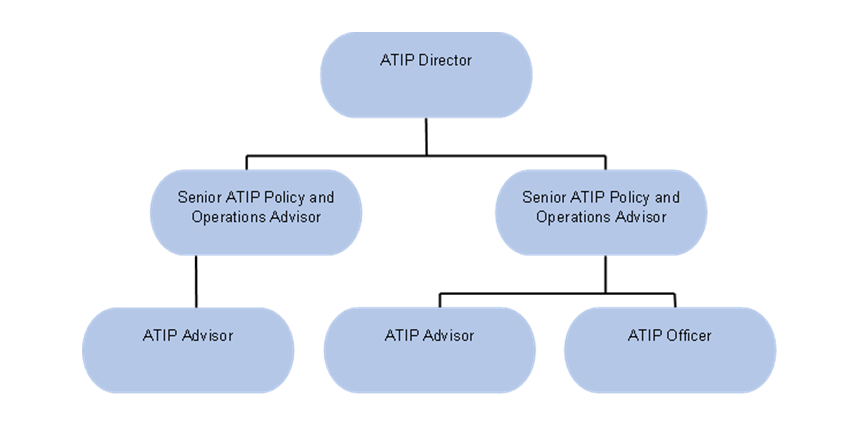
Text Version
- ATIP Director
- Senior ATIP Policy and Operations Advisor
- ATIP Officer
- Senior ATIP Policy and Operations Advisor
- ATIP Advisor
- ATIP Advisor
- Senior ATIP Policy and Operations Advisor
Part 2 of the Act requires that government institutions proactively publish popular types of government information within certain timelines. Responsibilities under Part 2 are shared between several corporate services at the PPSC. The ATIP Office acts as a centre of expertise for proactive publication and reviews many of the proposed disclosures prior to publication.
For a breakdown of the groups responsible for meeting each applicable proactive publication requirement under Part 2 and how they monitor compliance, see section 6 (Proactive publication) and section 11 (Monitoring compliance), respectively, of this report.
4 Delegated authorities
Pursuant to subsection 95(1) of the Act, the head of a government institution may designate one or more officers or employees of that institution, by order, to exercise or perform any of the powers, duties, or functions of the head of the institution under the Act.
The DPP, as the “head of institution,” has designated this authority to the Director General, CPA, as well as the Senior Director General, Corporate Services, and the ATIP Director. The ATIP Director exercises this authority in the absence of the Director General, CPA. The Senior Director General, Corporate Services, exercises this authority in the absence of both the Director General, CPA, and the ATIP Director.
A signed copy of the ATIP Delegation Order is available in Appendix A of this report.
5 Performance
The following section provides an overview of key data on the PPSC’s performance for the 2025-2026 fiscal year.
5.1 Requests received under the Access to Information Act
5.1.1 Number of requests
With the exception of two (2) requests received by mail, all access to information requests were submitted through the ATIP Online Request Service. This reflects the broader shift toward predominately digital service delivery for ATIP requests.
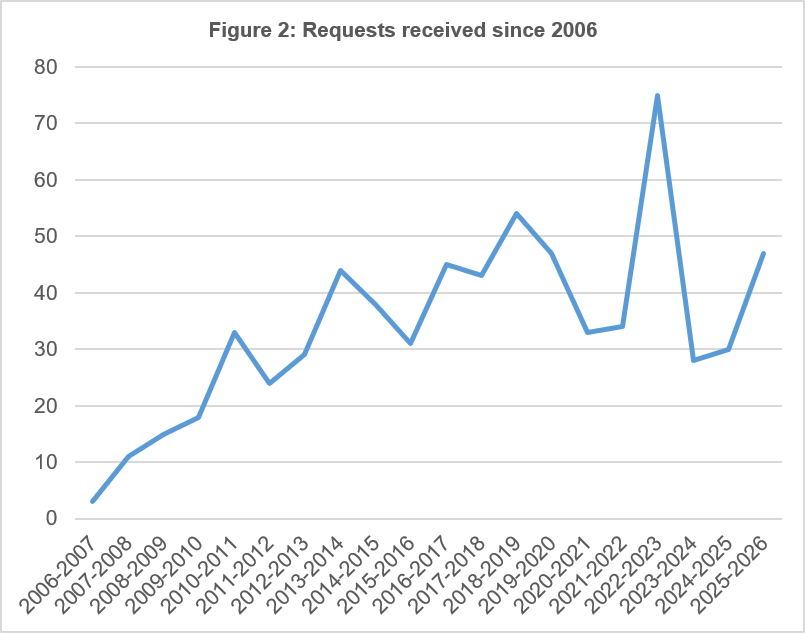
The PPSC received 47 new formal access to information requests in 2025-2026. This is a 57% increase from the 30 received in 2024-2025. Additionally, seven (7) requests were carried over from the previous period: six (6) received within the final months of the fiscal year and one (1) other received in 2021-2022. Altogether, the PPSC had 54 requests to process in 2025-2026.
Since its creation, the PPSC has received 682 access to information requests in total. Overall, with some fluctuations, the number of requests has grown from year to year, peaking sharply in 2022-2023 due to increased interest from applicants on high-profile subject matter. Since then, demand has returned to more typical levels. The following chart illustrates this trend:
Text Version
| Fiscal year | Number of requests |
|---|---|
| 2006-2007 | 3 |
| 2007-2008 | 11 |
| 2008-2009 | 15 |
| 2009-2010 | 18 |
| 2010-2011 | 33 |
| 2011-2012 | 24 |
| 2012-2013 | 29 |
| 2013-2014 | 44 |
| 2014-2015 | 38 |
| 2015-2016 | 31 |
| 2016-2017 | 45 |
| 2017-2018 | 43 |
| 2018-2019 | 54 |
| 2019-2020 | 47 |
| 2020-2021 | 33 |
| 2021-2022 | 34 |
| 2022-2023 | 75 |
| 2023-2024 | 28 |
| 2024-2025 | 30 |
| 2025-2026 | 47 |
| Total | 682 |
5.1.2 Subject matter
The subject matter of the 47 requests received in 2025-2026 was varied and often involved overlapping categories. However, a few key themes can be observed:
- Consistent with the PPSC’s mandate, 53% of requests received concerned criminal and regulatory prosecutions and investigations.
- Notably, there was interest in organizational and operational data. More than half of all requests received sought data on topics such as the PPSC workforce, expenditures and compensation, information technology, facilities and accommodations, legal agents, and prosecution trends.
5.1.3 Sources
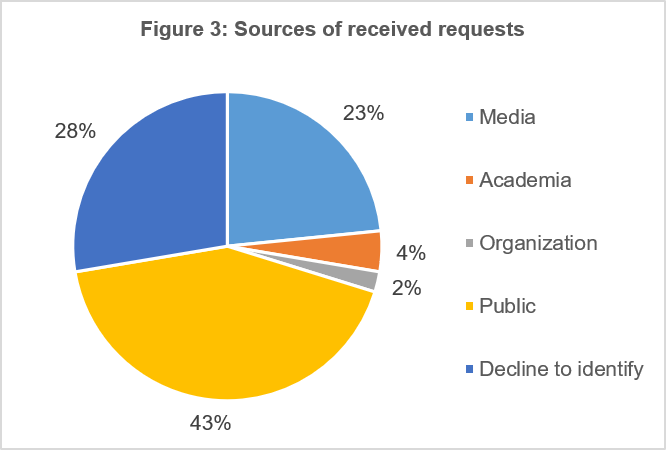
For the 47 requests received in 2025-2026, 43% of applicants self-identified as general members of the public. Another 28% declined to self-identify. In recent years, a sizeable portion of applicants have chosen not to self-identify, representing 34% of all requests received over the last five fiscal years.
The following chart shows the distribution of all requests received in 2025-2026 by source:
Text Version
| Source | Number of requests | % |
|---|---|---|
| Media | 11 | 23% |
| Academia | 2 | 4% |
| Organization | 1 | 2% |
| Public | 20 | 43% |
| Decline to identify | 13 | 28% |
| Total | 47 | 100% |
5.1.4 Informal requests
An informal request is any request for information made to the ATIP Office of a government institution that is not processed under the Act. Fees cannot be charged for informal requests and there are no legislated deadlines for response. Additionally, the applicant has no legal right of complaint to the OIC.
The PPSC typically receives most informal requests online through the Open Government Portal, where the PPSC publishes a monthly summary of completed access to information requests. Applicants have the ability to submit an informal request through the Portal for any records that were released in response to completed requests.
During the 2025-2026 fiscal year, the PPSC received 71 informal requests, substantially less than the 154 informal requests received in the previous fiscal year. The previous spike in informal requests was due to a single group of applicants seeking every copy of responsive records for access to information requests completed at the PPSC that was still available for re-release at the time.
No informal requests were carried over from the previous period.
The PPSC responded to all but one (1) request during the fiscal year, all closed within the first 15 days of receipt. The effort involved in processing these requests required that the PPSC re-release a total of 210, 276 pages to informal applicants, 15% fewer than pages processed during the previous year.
Throughout the fiscal year, the ATIP Office also prepared responses to Parliamentary Questions as well as provided advice and recommendations to PPSC employees regarding various reports on audits, workplace violence investigations, and information to be proactively published. The ATIP Office reviewed these reports to ensure that sensitive information, such as solicitor-client privileged and personal information, was identified and protected prior to publication or disclosure to the relevant parties.
5.2 Requests closed during the fiscal year
5.2.1 Disposition of requests
The PPSC responded to 49 formal access to information requests in 2025-2026, 81% more than the 27 requests closed in 2024-2025. Over the last five fiscal years, on average, the PPSC has closed 83% of requests received in a given year or carried over from a previous period.
There were also fewer requests that remained open at the end of the current fiscal year. As compared with the seven (7) requests carried over from the previous period, five (5) requests remained outstanding as of March 31, 2026. Of these, four (4) were received during the reporting period, and one (1) was received in 2021-2022. Additional time was needed to process the older request due to the complexity of the subject matter and the large volume of relevant records, consisting of more than 46,000 pages. All five (5) requests outstanding at the end of the current reporting period were still within legislated timelines.
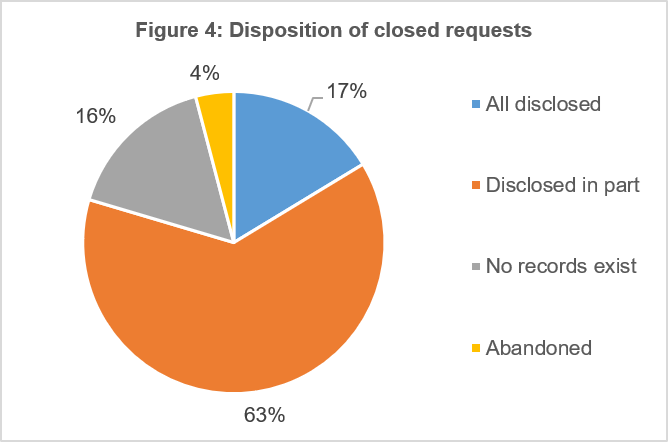
For requests closed in 2025-2026, the disposition is as follows:
Text Version
| Disposition of requests | Number of requests | % |
|---|---|---|
| All disclosed | 8 | 16% |
| Disclosed in part | 31 | 63% |
| No records exist | 8 | 16% |
| Abandoned | 2 | 4% |
| Total | 49 | 100% |
Of the 49 requests closed in 2025-2026, records were fully or partially disclosed in 39 cases. On average, 78% of requests closed over the past five fiscal years have resulted in full or partial disclosure of records to applicants.
During the current reporting period, the PPSC closed the following requests which did not result in disclosure of any records on the part of the organization:
No records exist
Eight (8) requests could not be processed because relevant records under the control of the PPSC did not exist. Where possible, applicants were advised of other government institutions that may have records and were provided with contact information accordingly.
Abandoned
Two (2) requests were abandoned by the applicant. In most abandoned cases, clarification is needed from the applicants in order to process their requests. When the applicants do not provide clarification, the requests are deemed as abandoned. In other cases, the applicants choose to abandon their requests.
5.2.2 Number of pages processed
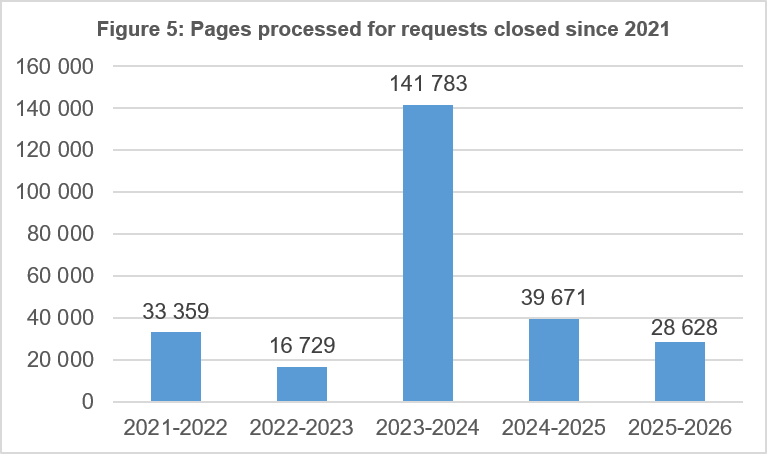
In closing 49 requests in 2025-2026, the PPSC processed a total of 28,628 pages, which is 28% fewer than the 39,671 pages processed in 2024-2025.
The PPSC ATIP Office also reviewed an additional 2,880 pages received from across the organization. These pages were deemed as not relevant to the requests and were therefore not included as part of the responses.
The following is a summary of the relevant pages processed by the PPSC over the last five fiscal years:
Text Version
| Fiscal year | Number of pages |
|---|---|
| 2021-2022 | 33,359 |
| 2022-2023 | 16,729 |
| 2023-2024 | 141,783 |
| 2024-2025 | 39,671 |
| 2025-2026 | 28,628 |
| Total | 260,170 |
5.2.3 Completion time
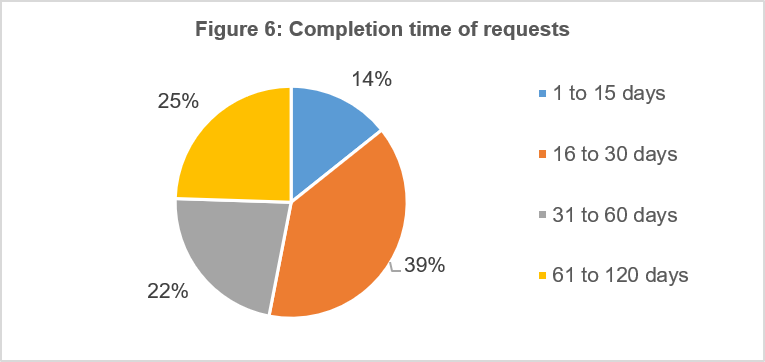
Of the 49 requests closed in 2025-2026, more than half of requests (26) were completed within the initial 30-day statutory deadline. An additional 11 requests were processed within the 31 and 60 days, while the remaining 12 were closed within 61 and 120 days.
The following summarizes the number of days taken to respond to requests:
Text Version
| Completion time | Number of requests | % |
|---|---|---|
| 1 to 15 days | 7 | 14% |
| 16 to 30 days | 19 | 39% |
| 31 to 60 days | 11 | 22% |
| 61 to 120 days | 12 | 24% |
| Total | 49 | 100% |
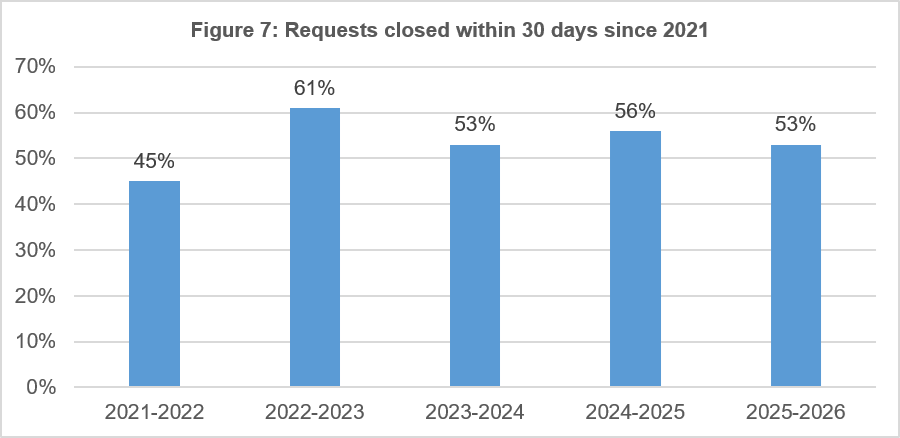
Overall, the PPSC has processed 55% of the access to information requests closed over the last five fiscal years within 30 days of receipt. The proportion of requests closed within this timeframe each year is as follows:
Text Version
| Fiscal year | % of closed requests |
|---|---|
| 2021-2022 | 45% |
| 2022-2023 | 61% |
| 2023-2024 | 53% |
| 2024-2025 | 56% |
| 2025-2026 | 53% |
5.2.4 Exemptions
The right of access to information in government records is subject to limited and specific exceptions. Limitations to the right of access are set out in sections 13 through 24 of the Act. Section 26 also sets out an administrative exception relating to the publication of information.
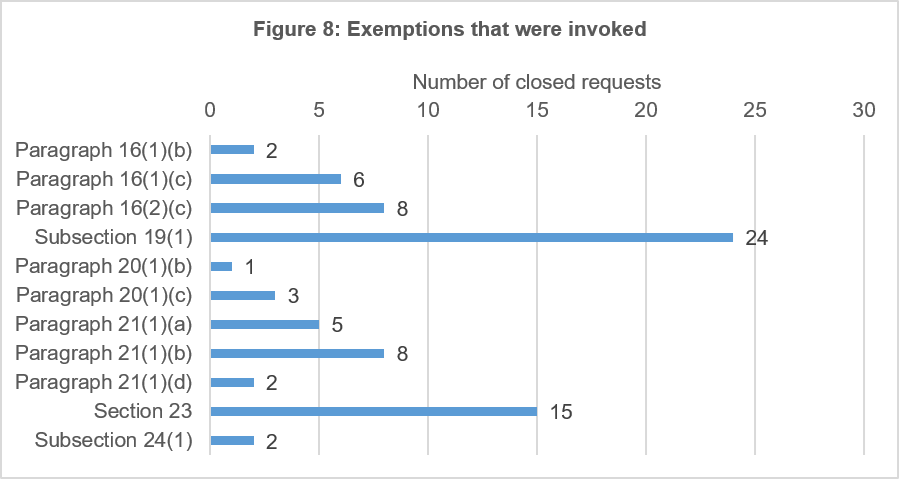
The following is a breakdown of the exemptions applied by the PPSC in 2025-2026 for closed requests:
Text Version
| Exemption | Number of requests |
|---|---|
| Paragraph 16(1)(b) | 2 |
| Paragraph 16(1)(c) | 6 |
| Paragraph 16(2)(c) | 8 |
| Subsection 19(1) | 24 |
| Paragraph 20(1)(b) | 1 |
| Paragraph 20(1)(c) | 3 |
| Paragraph 21(1)(a) | 5 |
| Paragraph 21(1)(b) | 8 |
| Paragraph 21(1)(d) | 2 |
| Section 23 | 15 |
| Subsection 24(1) | 2 |
Over the past five fiscal years, the PPSC has most frequently invoked subsection 19(1) (personal information) and section 23 (solicitor-client privilege) of the Act to exempt information from disclosure. This trend reflects the PPSC’s mandate to conduct federal prosecutions, which often involve personal information, and to provide legal advice to law enforcement agencies and investigative bodies on prosecution-related matters.
5.2.5 Exclusions
Records or parts thereof to which the Act does not apply are considered to be “excluded.” Pursuant to section 68, the Act does not apply to published material or material available for purchase by the public, library or museum material preserved solely for public record, or material placed in Library and Archives Canada. Records containing confidences of the King’s Privy Council of Canada, also known as Cabinet confidences, and which have been in existence for less than 20 years are also excluded from the Act pursuant to section 69.
In 2025-2026, the PPSC invoked subsection 68(a) on one (1) occasion because some of the material requested was already publicly accessible. In another case, the PPSC invoked paragraph 69(1)(g) because the records in question referred to Cabinet confidences about the agenda, deliberations, or decisions of Council as well as communications or discussions between Cabinet Ministers on matters relating to the making of government decisions or the formulation of government policy.
5.2.6 Format of information released
Information was released electronically for all 39 requests where the PPSC fully or partially disclosed records in 2025-2026.
In the last five fiscal years, all releases have been in electronic format. At the onset of the COVID-19 pandemic in 2020, the PPSC, along with the majority of government agencies and the private sector, had shifted its services to a digital-first environment in order to comply with public health measures. While paper-based release packages can be made available upon request so that the ATIP process remains accessible to all Canadians, PPSC applicants no longer request this option.
5.2.7 Complexity
Due to the nature of the PPSC’s work, processing requests can be challenging, and requests are regularly deemed “complex” based on a number of factors:
- Records held by the PPSC may contain information related to matters involving other federal, provincial, or territorial organizations. As a result, consultations with these organizations may be required to determine whether certain records can be disclosed.
- The ATIP Office may seek legal advice regarding the relevance or disclosure of records, which can further complicate the processing of a request.
- Many requests involve records held in regional offices across Canada, requiring coordinated searches in multiple locations. In certain cases, a single request may necessitate the retrieval of records from all regions, adding to the complexity of request processing.
- Some records require particularly in-depth analysis due to high-profile or highly sensitive subject matter.
- A database search can complicate the retrieval of records, often requiring extensive coordination between ATIP officials, business analysts, and subject matter experts to extract, package, and validate relevant data.
5.2.8 Deemed refusals
Requests that are not closed within the initial 30-day statutory deadline or within a timeframe covered by an extension under the Act are referred to as “deemed refusals.” Further information on the circumstances in which an extension to the original deadline is permitted by the Act is available in section 5.3 (Extensions) of this report.
The PPSC maintained full compliance with the requirements of the Act, completing all 49 requests closed during 2025-2026 within the initial statutory deadline or an authorized extension period. This represents a compliance rate of 100%.
5.2.9 Requests for translation
Just as it has been the case over the last five fiscal years, the PPSC did not receive any requests from applicants in 2025-2026 to translate records from one official language to the other.
5.3 Extensions
Section 9 of the Act permits government institutions to extend the 30-day statutory deadline for processing a request in cases when:
- institutions must review or search through a large number of records;
- consultations with legal counsel or the Privy Council Office are required to determine whether records should be excluded under section 69 (Cabinet confidences) of the Act;
- consultations with other institutions are necessary to obtain their recommendations on disclosure; or
- notice must be given to third parties regarding the potential release of their information.
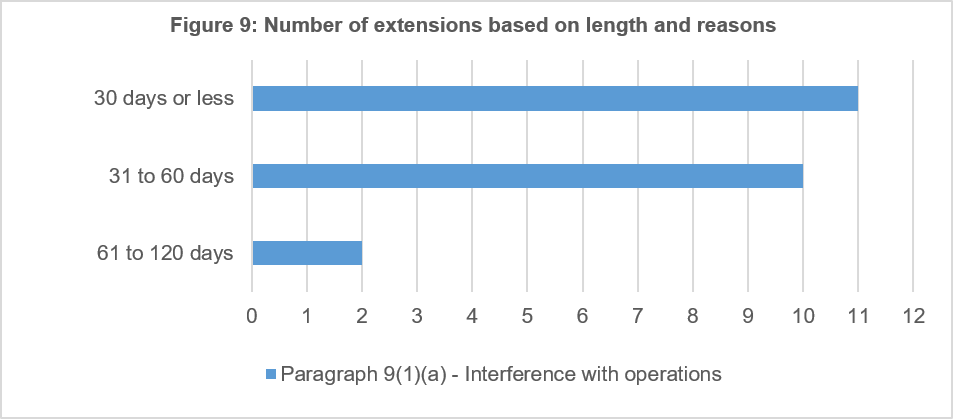
The PPSC took extension for 23 requests closed in 2025-2026, ten (10) more extensions than in the previous period. In all cases, extensions were taken because the volume of records involved could not be processed within the initial statutory timeframe without unreasonably interfering with the operations of the PPSC.
Over the past five fiscal years, the PPSC has taken an average of 19 extensions per year under the Act. Overall, requests have become increasingly complex to process, and extensions are often necessary to meet obligations under the Act, whether due to the volume of pages to review, the need for extensive searches, or consultations with other government institutions.
The following chart summarizes the length and reasons for the extensions taken in 2025-2026:
Text Version
| Length of extensions | Paragraph 9(1)(a) - Interference with operations |
|---|---|
| 30 days or less | 11 |
| 31 to 60 days | 10 |
| 61 to 120 days | 2 |
| Total | 23 |
5.4 Consultations received from other institutions
5.4.1 Number of consultations
The PPSC received 17 consultations from other government institutions for processing under the Act in 2025-2026, one (1) more than in 2024-2025. Three (3) other consultations were carried forward from that period to the current fiscal year. Altogether, the PPSC had 20 consultations to process in 2025-2026.
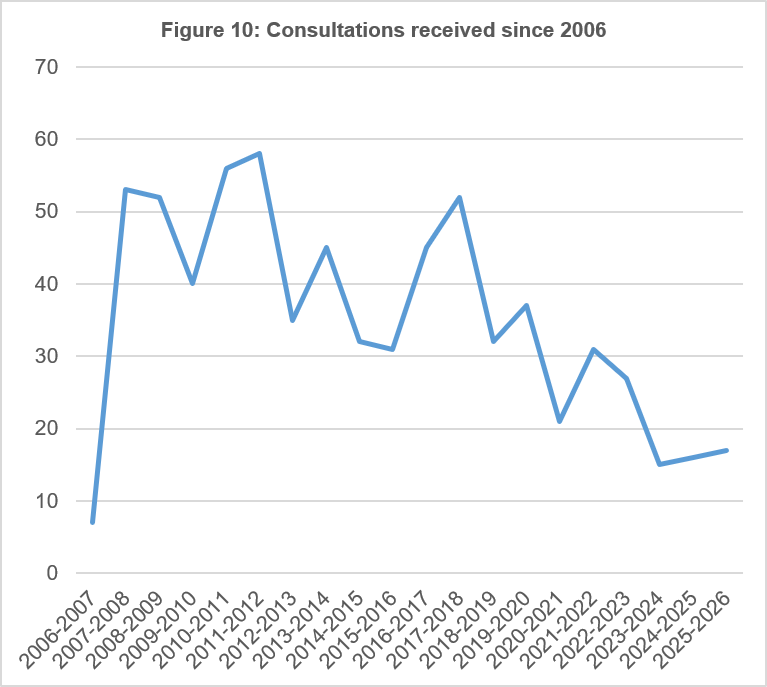
Since its creation on December 12, 2006, the PPSC has received a total of 702 access to information consultations, peaking at 58 consultations in 2011-2012. As illustrated in the chart below, while annual volumes have continued to fluctuate, the number of consultations has declined significantly in recent years:
Text Version
| Fiscal year | Number of consultations |
|---|---|
| 2006-2007 | 7 |
| 2007-2008 | 53 |
| 2008-2009 | 52 |
| 2009-2010 | 40 |
| 2010-2011 | 56 |
| 2011-2012 | 58 |
| 2012-2013 | 35 |
| 2013-2014 | 45 |
| 2014-2015 | 32 |
| 2015-2016 | 31 |
| 2016-2017 | 45 |
| 2017-2018 | 52 |
| 2018-2019 | 32 |
| 2019-2020 | 37 |
| 2020-2021 | 21 |
| 2021-2022 | 31 |
| 2022-2023 | 27 |
| 2023-2024 | 15 |
| 2024-2025 | 16 |
| 2025-2026 | 17 |
| Total | 702 |
5.4.2 Sources of consultations
Of the 17 consultations received by the PPSC in 2025-2026, the Treasury Board of Canada Secretariat (TBS) was the most frequent source. Compared with consultations related to prosecutions, TBS consultations generally involve fewer pages and less complex subject matter.
The following table identifies the number of consultations sent by each government institution in 2025-2026:
| Source | Number of consultations | % |
|---|---|---|
| Treasury Board of Canada Secretariat | 7 | 41% |
| Fisheries and Oceans Canada | 3 | 18% |
| Canadian Security Intelligence Service | 1 | 6% |
| Department of Canadian Heritage | 1 | 6% |
| Privy Council Office | 1 | 6% |
| Public Safety Canada | 1 | 6% |
| Public Services and Procurement Canada | 1 | 6% |
| Service Nova Scotia and Internal Services | 1 | 6% |
| Shared Services Canada | 1 | 6% |
| Total | 17 | 100% |
5.4.3 Disposition and recommendations
The PPSC responded to 19 of the 20 consultations to process in 2025-2026. The one (1) remaining consultation was received at the end of the reporting period and carried over to the next fiscal year. It was still within negotiated timelines as of March 31, 2026.
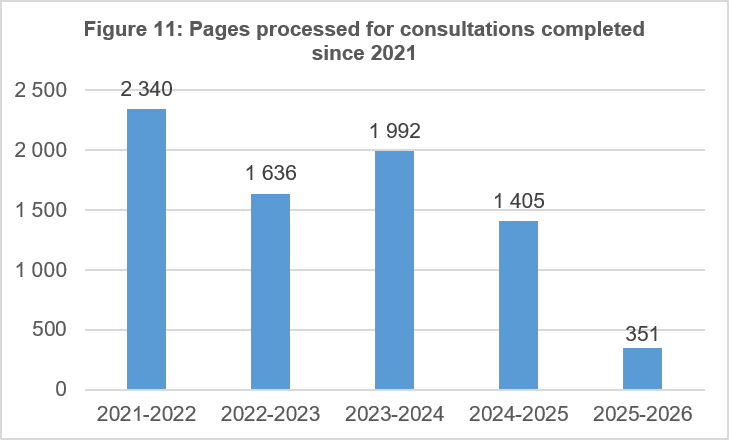
A total of 351 pages were processed for the 19 consultations completed in 2025-2026, substantially fewer than the 1,405 pages processed in the previous period. Over the last five years, the PPSC has processed an average of 1,545 pages each year in response to consultations. The total number of pages processed during this timespan is as follows:
Text Version
| Fiscal year | Number of pages processed |
|---|---|
| 2021-2022 | 2,340 |
| 2022-2023 | 1,636 |
| 2023-2024 | 1,992 |
| 2024-2025 | 1,405 |
| 2025-2026 | 351 |
| Total | 7,724 |
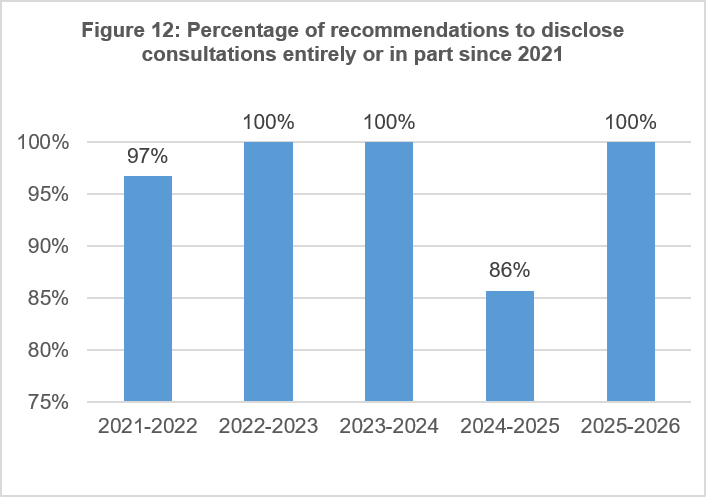
For the 19 consultations completed in 2025-2026, the PPSC recommended that the other government institutions disclose records: full disclosure in 11 cases and partial disclosure in eight (8) other cases.
Overall, the PPSC has completed 107 consultations over the last five fiscal years. During this period, the PPSC’s recommendations have consistently leaned toward disclosure, whether in full or in part. The following chart illustrates this trend:
Text Version
| Recommendation | % of completed consultations | ||||
|---|---|---|---|---|---|
| 2021-2022 | 2022-2023 | 2023-2024 | 2024-2025 | 2025-2026 | |
| Disclose entirely or in part | 97% | 100% | 100% | 86% | 100% |
5.4.4 Completion time
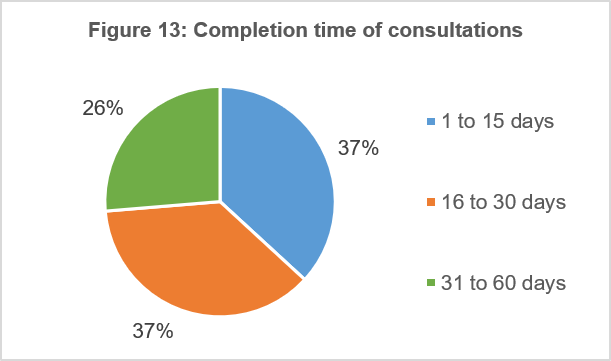
Of the 19 consultations completed in 2025-2026, 14 (74%) were processed within 30 days of receipt, representing an increase of two (2) consultations compared with the previous reporting period. This performance aligns closely with the five-year average, with 77% of consultations completed within the same timeframe.
The PPSC responded to the five (5) other consultations between 31 to 60 days in 2025-2026.
The following chart breaks down the proportion of consultations completed within each timeframe during the current reporting period:
Text Version
| Completion time | Number of consultations | % |
|---|---|---|
| 1 to 15 days | 7 | 37% |
| 16 to 30 days | 7 | 37% |
| 31 to 60 days | 5 | 26% |
| Total | 19 | 100% |
5.5 Consultations on Cabinet confidences
The PPSC ATIP Office consulted the PPSC’s Corporate Counsel in 2025-2026 on one (1) occasion regarding section 69 of the Act, which relates to Cabinet confidences. This consultation involved 33 pages, and no records were released as a result.
5.6 Service fees and costs
The Act authorizes the collection of fees for processing formal requests for information. In accordance with the Treasury Board’s Directive on Access to Information Requests, the PPSC waives all prescribed fees other than the $5 application fee set out in paragraph 7(1)(a) of the Regulations.
The PPSC collected $235 in application fees for the 47 access to information requests received in 2025-2026. No fees were waived, and no refunds were issued during the reporting period.
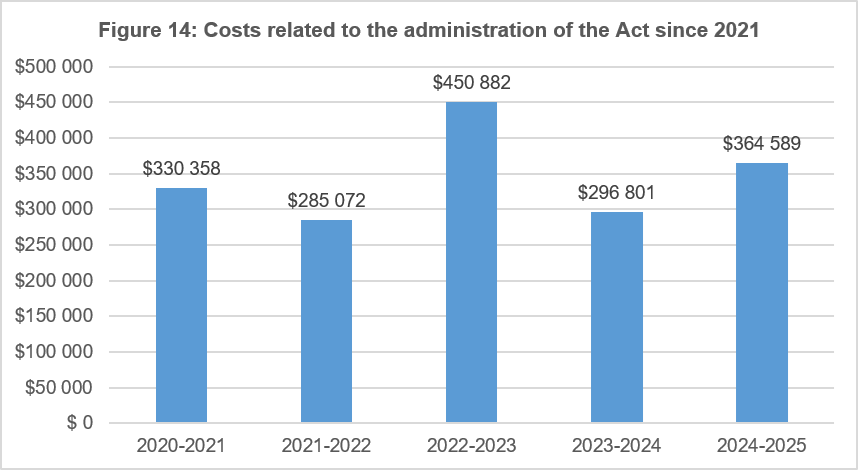
Throughout the reporting period, the PPSC spent a total of $364,589 administering the Act, of which salaries accounted for nearly all expenditures at $355,244, while goods and services accounted for the remaining $9,345. No overtime expenditures were incurred during this period.
Over the past five fiscal years, the costs associated with administering the Act have fluctuated, peaking in 2023-2024. The substantial increase in expenditures during that period was related to goods and services, specifically the purchase of licenses for new ATIP case management software.
The following chart illustrates annual costs over five years:
Text Version
| Fiscal year | Costs |
|---|---|
| 2021-2022 | $330,358 |
| 2022-2023 | $285,072 |
| 2023-2024 | $450,882 |
| 2024-2025 | $296,801 |
| 2025-2026 | $364,589 |
6 Proactive publication
Various corporate services at the PPSC are responsible for ensuring that their respective publications are proactively published online further to Part 2 of the Act. Additional information on how these groups fulfill their obligations under Part 2 is available in section 11 (Monitoring Compliance) of this report.
The following table summarizes the publications that the organization was responsible for posting online in 2024-2025 as well as its rate of compliance with legislated timelines:
Table 2: Proactive publication
| Legislative Requirement | Section of ATIA | Publication Timeline | Does the requirement apply to your institution? (Y/N) | Internal group(s) or positions(s) responsible for fulfilling requirement | % of proactive publication requirements published within legislated timelines | Link to web page where published |
|---|---|---|---|---|---|---|
| Travel Expenses | 82 | Within 30 days after the end of the month of reimbursement | Yes | Finance and Acquisitions Directorate | 100% | Government Travel Expenses |
| Hospitality Expenses | 83 | Within 30 days after the end of the month of reimbursement | Yes | Finance and Acquisitions Directorate | 100% | Government Hospitality Expenses |
| Reports tabled in Parliament | 84 | Within 30 days after tabling | Yes | ATIP Office, Communications, and Strategic Planning and Performance Measurement Unit | 100% | PPSC Publications |
| Legislative Requirement | Section of ATIA | Publication Timeline | Does the requirement apply to your institution? (Y/N) | Internal group(s) or positions(s) responsible for fulfilling requirement | % of proactive publication requirements published within legislated timelines | Link to web page where published |
|---|---|---|---|---|---|---|
| Contracts over $10,000 | 86 | Q1-3: Within 30 days after the quarter | Yes | Finance and Acquisitions Directorate | 75% | Government Contracts over $10,000 |
| Q4: Within 60 days after the quarter | ||||||
| Grants & Contributions over $25,000 | 87 | Within 30 days after the quarter | No | Not applicable | Not applicable | Not applicable |
| Packages of briefing materials prepared for new or incoming deputy heads or equivalent | 88(a) | Within 120 days after appointment | Yes | Ministerial and Parliamentary Affairs Unit | Not applicable - none prepared | Not applicable |
| Titles and reference numbers of memoranda prepared for a deputy head or equivalent, that is received by their office | 88(b) | Within 30 days after the end of the month received | Yes | Ministerial and Parliamentary Affairs team | 100% | Briefing Note Titles and Numbers |
| Packages of briefing materials prepared for a deputy head or equivalent’s appearance before a committee of Parliament | 88(c) | Within 120 days after appearance | No | Not applicable | Not applicable | Not applicable |
| Legislative Requirement | Section of ATIA | Publication Timeline | Does the requirement apply to your institution? (Y/N) | Internal group(s) or positions(s) responsible for fulfilling requirement | % of proactive publication requirements published within legislated timelines | Link to web page where published |
|---|---|---|---|---|---|---|
| Reclassification of positions | 85 | Within 30 days after the quarter | Yes | Human Resources Directorate | 100% | Government Position Reclassification |
| Legislative Requirement | Section of ATIA | Publication Timeline | Does the requirement apply to your institution? (Y/N) | Internal group(s) or positions(s) responsible for fulfilling requirement | % of proactive publication requirements published within legislated timelines | Link to web page where published |
|---|---|---|---|---|---|---|
| Packages of briefing materials prepared by a government institution for new or incoming ministers | 74(a) | Within 120 days after appointment | Yes | Ministerial and Parliamentary Affairs Unit | 100% | PPSC Transition Book |
| Titles and reference numbers of memoranda prepared by a government institution for the minister, that is received by their office | 74(b) | Within 30 days after the end of the month received | Yes | Ministerial and Parliamentary Affairs Unit | 100% | Briefing Note Titles and Numbers |
| Package of question period notes prepared by a government institution for the minister and in use on the last sitting day of the House of Commons in June and December | 74(c) | Within 30 days after last sitting day of the House of Common in June and December | No | Not applicable | Not applicable | Not applicable |
| Packages of briefing materials prepared by a government institution for a minister’s appearance before a committee of Parliament | 74(d) | Within 120 days after appearance | No | Not applicable | Not applicable | Not applicable |
| Travel Expenses | 75 | Within 30 days after the end of the month of reimbursement | No | Not applicable | Not applicable | Not applicable |
| Hospitality Expenses | 76 | Within 30 days after the end of the month of reimbursement | No | Not applicable | Not applicable | Not applicable |
| Contracts over $10,000 | 77 | Q1-3: Within 30 days after the quarter | No | Not applicable | Not applicable | Not applicable |
| Q4: Within 60 days after the quarter | ||||||
| Ministers’ Offices Expenses | 78 | Within 120 days after the fiscal year | No | Not applicable | Not applicable | Not applicable |
The PPSC proactively published information within legislated timelines 100% of the time, with one (1) exception. To respond to urgent priorities with limited resources at the time, the posting of the report listing contracts and amendments over $10,000 was delayed for one (1) of the fiscal quarters.
Other publication requirements under Part 2 of the Act do not apply to the PPSC since the relevant documents are not in use at the organization or none were prepared during the reporting period.
7 Training and awareness activities
One (1) formal training session was delivered to PPSC employees in 2025-2026 for 14 employees.
Presentations were also delivered in the past to raise awareness of corporate responsibilities regarding ATIP, including proactive publication requirements. These materials continue to be made available to all PPSC employees through the internal website. Communiqués on ATIP topics were also distributed throughout the year to employees, which included promoting International Right to Know Day 2025.
ATIP personnel provided informal learning to employees on an ad hoc basis regarding the processing of access to information requests and regularly provided advice to PPSC officials on the interpretation of the Act, including proactive publication.
8 Policies, guidelines, and procedures
No new or revised internal policies, guidelines, and procedures related to access to information were implemented for the organization in 2025-2026.
Each corporate service responsible for proactive publication under Part 2 of the Act has procedures in place to collect the required information from their databases and post it online within legislated timelines. The general procedures are described in section 11 (Monitoring Compliance) of this report.
9 Initiatives and projects to improve access to information
The PPSC launched a new electronic case management system in 2025-2026, ATIPXpress, with enhanced features for processing ATIP requests and performance tracking.
To support the transition, the PPSC ATIP Office developed written guidance for its staff. The team also updated office correspondence templates, so that they are compatible with the new system, as well as to improve communications with applicants and PPSC officials.
10 Complaints and investigations
Decisions made under the Act are subject to a two-tiered system of review. This ensures government institutions’ compliance with their access to information obligations as well as fair treatment for all applicants. The first level of review is a formal complaint made to and investigated by the Information Commissioner, supported by the Office of the Information Commissioner (OIC). The second level is an application for judicial review to the Federal Court. The PPSC reviews the outcomes of all investigations and incorporates lessons learned into business processes, where appropriate.
Two (2) new complaints were filed with the OIC against the PPSC in 2025-2026, one (1) of which was discontinued by the end of the reporting period. This complainant alleged that the PPSC improperly applied exemptions to the records provided to them.
The other new investigation remained active as of March 31, 2026. In this case, the complainant alleged that there were records missing from the package disclosed in response to their request.
There were no applications for judicial review filed with the Federal Court in 2025-2026.
11 Monitoring compliance
The ATIP Office maintains a comprehensive statistical reporting and performance measurement system to track the processing of formal requests, informal requests, and consultations received by the PPSC.
Each ATIP staff member is responsible for monitoring the time taken to process files that they are assigned on a regular basis, while the Senior ATIP Advisors meet with the ATIP Director twice a week to review timelines and address challenges that could affect the PPSC’s ability to meet its legal obligations under the Act. The ATIP Director meets weekly with the ATIP Coordinator on the status of active requests, complaints, and any issues that have arisen. The ATIP Office also formally reports to the PPSC’s senior management on a regular basis about its activities, caseload, performance metrics, and trends related to access to information.
The Director of each corporate service at the PPSC is responsible for monitoring compliance with Part 2 of the Act, so that their section’s information is proactively made available online and on time. The following general steps are taken by each group to support timeliness, accuracy, and completeness:
- The frequency with which compliance is monitored in a given area depends on how often the information must be published according to legislated timelines.
- Content is prepared in advance by subject matter experts in accordance with Treasury Board requirements. This may include the collection and verification of data. Some data and other key inputs for reports or briefing materials are gathered from other corporate services or regional offices responsible for prosecutions.
- Each corporate service has established processes for translating and formatting content in accordance with online publishing and web accessibility standards. These processes also include consulting relevant stakeholders, such as the ATIP Office, as needed.
- The DPP’s final approval is required for all publications before they are made available online or tabled in Parliament, as well as the approval of other senior PPSC officials, such as Director Generals responsible for their respective areas and the Deputy Directors of Public Prosecutions.
- Content published on the PPSC’s Internet site is coded by the Communications team, while datasets are updated directly on the Open Government Portal.
12 Appendix A – Delegation order
Access to Information Act and Privacy Act Delegation Order
The Director of Public Prosecutions, pursuant to subsection 95(1) of the Access to Information Act and subsection 73(1) of the Privacy Act, hereby designates the persons holding the positions set out in the schedule hereto, or the persons occupying on an acting basis those positions, to exercise the powers, duties and functions of the Director of Public Prosecutions as the head of the Office of the Director of Public Prosecutions, under the provisions of the Acts and related regulations set out in the schedule opposite each position. This designation replaces all previous delegation orders.
| Position | Access to Information Act and Regulations | Privacy Act and Regulations |
|---|---|---|
| Senior Director General, Corporate Services | Full authority | Full authority |
| Director General, Communications and Parliamentary Affairs | Full authority | Full authority |
| Director, ATIP | Full authority | Full authority |
Dated, at the City of Ottawa, this 8th day of August 2024
George Dolhai
Director of Public Prosecutions
- Date modified: